•A live report from the tin mining field in Bangka Belitung in the form of an essay.
•Journalists have detected illegal collusion between individuals.
•A perspective from residents who first encountered tin mining activities in February 2013.
ENGLISH VERSION
Pangkalpinang atensipublik.com – How long will law enforcement and related agencies in the province of Bangka Belitung remain ambiguous about the state of the environment and ecosystems that have been severely damaged? What should be passed on to our children and grandchildren to prepare them for competition in the future is instead being exploited for the benefit of certain groups or individuals. The village of Tirus Simpang Lumut in Belinyu District, Bangka Regency, is one such example. Here, they freely display the acute collusion between corrupt authorities and businesspeople.
As a result, illegitimate children were born, living a luxurious lifestyle typical of the bourgeoisie-capitalists. When one of the sources met with the author—who happened to be a miner there—and was interviewed, he said, “Oh, sir, if you want to ask about that, just ask the big boss,” and quickly moved on from the next question. The big boss he was referring to was not the mining authority at the mine site, but the person responsible for and owner of the capital. It is common knowledge here that the village of Tirus Simpang Lumut is known for its large number of illegal miners who venture deep into restricted areas—such as HL, HP, and mangrove forests—and the lack of raids. To see this problem comprehensively, let’s examine three crucial points that must be resolved here.
First, of course, is the issue of mining permits, which they certainly cannot legally and formally show by presenting tin mining permits or local government permits. Although there may be a handful who are able to show such formal legality. However, most of them simply utter the magic word “coordination.” It is suspected that what they mean is that they have been regularly paying a percentage of their illegal mining profits to unscrupulous individuals. With this bargaining power, they are able to enter areas that are actually off-limits for mining, such as in the hamlets of Tirus and Simpang Lumut in the Belinyu subdistrict.
They also shamelessly exploit natural resources that in other countries are regulated by quotas. Without strict regulations, they trample on government and legislative agreements regarding mining boundaries and encroach on protected forests, mangrove forests, and conservation areas. The second issue is taxation. Whether it’s heavy equipment taxes, local taxes, or royalties from tin production, these appear to have increased significantly in the annual reports of local governments. However, In fact, there is a sharp qualitative decline.
This means that while the figures presented as achievements and prestige of the local government tend to increase, what is actually happening on the ground is the opposite. In a paradoxical example, many houses in the area around the mine are still made of fragile wood.
Meanwhile, the use of technological household appliances, which of course require electricity, is still a distant dream. This is because electricity is currently a ‘luxury’ here. Also, if you look closely, this area resembles Indonesia when it had just emerged from colonialism. Children running around barefoot while wiping mucus from their noses are a common sight on village roads that resemble puddles. If we are sensitive and caring, we can often hear cries from the heart in this area.
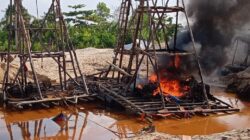
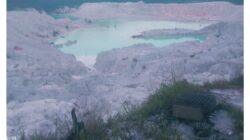
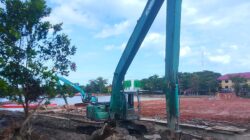
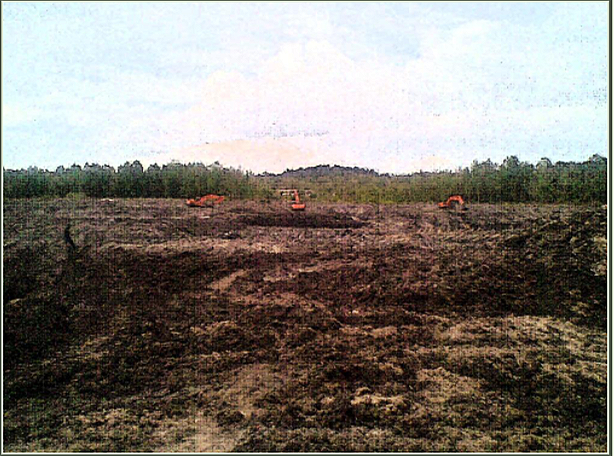
The next issue is the reclamation of former mining land. This most crucial and urgent matter seems to be a frightening specter for a handful of unscrupulous individuals who claim to represent small-scale mining. Surprisingly, it has even been legalized by absurd local regulations, leaving only a small space for environmental sustainability. Field observations indicate that there are no signs that land reclamation funds are being used properly and effectively in these former mining areas. As a result of these illegal activities, many forestry and agricultural programs have not been implemented due to the unclear allocation or designation of TI areas. If we refer to Law Number 23 of 1997 concerning Environmental Management, article 18 paragraph 1, it states that “every business plan and/or activity that has a significant and important impact must undergo an AMDAL assessment.” In the village of Tirus Simpang Lumut, illegal miners continue to secretly mine tin in this prohibited area. Other direct consequences include damage to river basins, coastal areas, protected forests, and production forests. The holes left behind by mining are barren because they have not been reclaimed. They are now out of control because most of them mine outside the PT Tambang Timah concession area. Almost all miners use large equipment such as excavators, which easily tear up the surface of the land.
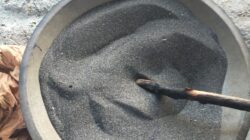
At several mining sites, the quality and quantity of the land has deteriorated. In the most severely affected areas, the brown soil has been replaced by a sea of sand that we tread on as we pass through. Perhaps we can look to the example of lead mining during the Roman Empire, which continued to produce acid mine drainage nearly 2,000 years later. Acid mine drainage only forms years later, so mining companies that do not conduct long-term monitoring may mistakenly assume that their waste rock does not cause acid mine drainage. So, as in heroic stories, anyone who dares to speak up about the importance of environmental preservation or saving Bangka’s damaged nature will immediately be subjected to psychological pressure. The invisible hands of the mob get involved. Becoming freaky people in the midst of the torrent of misguidance.
There is no prohibition whatsoever on processing the natural resources of our rich country. This is in accordance with the mandate of the founders of the nation in the 1945 Constitution, Article 33. And it cannot be denied that IT activities in Bangka Regency have spurred rapid economic growth. However, it is not only economic growth that IT has generated. The sporadic and mass mining activities have also caused tremendous environmental damage. Seeing this condition, it would be good to try a shock therapy for the tin regime – which is still in power today – by conducting an environmental awareness trial in the form of a study tour for junior high and high school students throughout the district to illegal tin mining sites. Then, conduct a simple questionnaire about the mining activities and environmental damage they have seen. Present the answers to the questionnaire to local officials, such as the local government, regional representative council, police, and military command, as a form of student concern for the environment. It is certain that stunned faces and gaping mouths will be seen everywhere. Only individuals who no longer have sound reasoning would say that unconventional tin mining In the village of Tirus Simpang Lumut, this is still at a reasonable and controllable level. In addition, an atmosphere of greed and avarice has truly taken root in their minds and hearts.
In fact, we must all begin to slow down and limit the flow of capital that is married to short-term interests in order to control this village. Because no matter how much maximum profit can be achieved from this unconventional tin mining activity, it is still not comparable to the environmental damage caused as a result. In conclusion, we are just waiting for the time when nature will finally be fed up with the damage caused by the actions of a handful of people who are destroying the earth. But how long will that take? (**)
by: M. Lukman Hakim
February 22, 2013